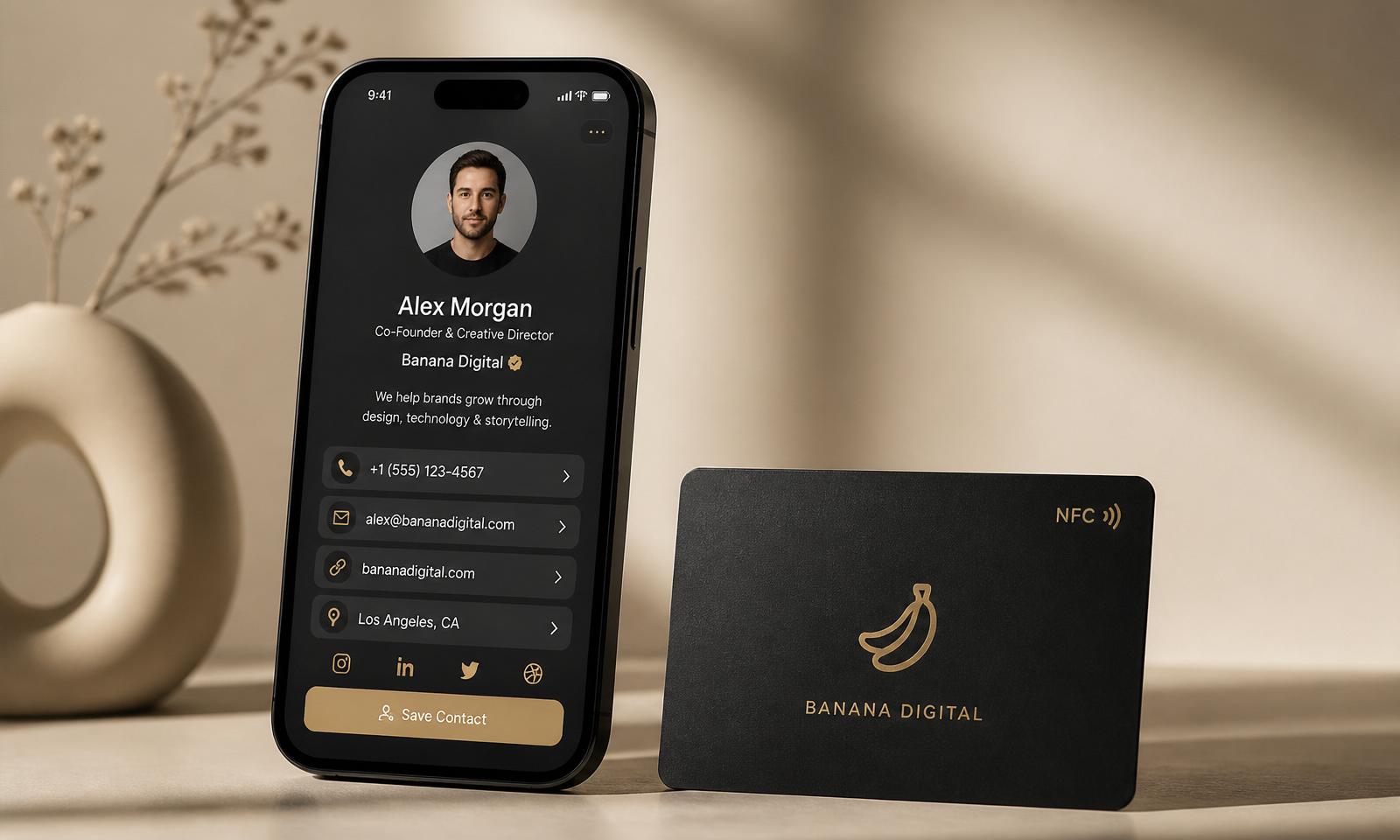
8 Best Digital Business Cards of 2026 (Ranked & Reviewed)
We reviewed and tested the 8 best digital business card platforms of 2026 — pricing, free plans, features, and where each one actually shines.
Paper cards are having a rough decade. They get crumpled in wallets, lost in drawers, and thrown out within a week of the handshake. Meanwhile the average professional now attends more events, joins more coffee chats, and swaps more contacts in a month than most of us used to in a quarter — and every one of those introductions is a lead that either lands cleanly in a phone or slips through the cracks.
That's why the digital business card category has quietly exploded. There are now dozens of platforms, all promising the same thing: tap a card, land in a phone, capture the contact, follow up. In practice, they're wildly different — different hardware, different follow-up tooling, different free plans (or none at all), and very different long-term value.
We spent the last several weeks setting up accounts on the biggest names in the space, tapping cards on real phones, and looking at what happens after the handshake — because that's where most of these platforms quietly fall apart. Below is the honest ranking of the eight we'd actually recommend in 2026, what each one is genuinely good at, and where each one falls short.
Image Here: hero image of eight different NFC business cards fanned out on a matte black surface, top-down photography, natural window light.
How we ranked them
Every card was scored across the same eight things:
- First impression — does the physical card and profile page look premium enough to hand over without hesitation?
- Time to first tap — from unboxing to a working card, how long?
- Contact capture — does the person on the other side get saved automatically, or is it "screenshot my QR" theatre?
- Follow-up — is there a system that keeps the contact warm, or does the platform stop at "sent"?
- CRM and workflow depth — pipelines, tasks, integrations, real business tooling.
- Analytics — plain metrics you can act on, not vanity dashboards.
- Free plan honesty — is the free tier usable, or is it a trailer for the paid one?
- Value at scale — what does the same setup cost a 20-person team in year two?
The order below is the order we'd hand these to a friend, not sponsorship rank. Where a competitor genuinely beats us at a specific job, we'll say so.
1. banana.cards — Best Overall (and best free plan)
Image Here: banana.cards metal card on a wooden desk next to a phone showing the profile page with a booking widget open.
We'll be upfront: banana.cards is us. So instead of asking you to trust the ranking, we'll tell you exactly what we do differently — and where the platforms below might suit you better.
The short version: banana.cards is the only platform on this list where the card is just the front door. Everything behind it — CRM, AI enrichment, contracts, bookings, automations, email — is built in the same box, by the same team, so the moment someone taps your card the contact flows into a real business system, not another silo you'll have to babysit.
What you get on the free plan:
- A hosted digital profile at
banana.cards/you— unlimited views, no watermark. - QR sharing, direct link, and Apple/Google Wallet pass.
- Basic contact capture (leads land in your dashboard).
- A live analytics page.
Compare that to Popl, HiHello, Wave Connect, and Blinq, whose free tiers cap contacts, cap cards, watermark the profile, or gate the sharing tools behind an upgrade prompt.
What the paid plan unlocks:
- A full CRM — every tap becomes a contact, every contact rolls into a pipeline.
- AI enrichment — pulls LinkedIn, company info, mutual connections onto every lead.
- Bookings — a Calendly replacement embedded in the card.
- Contracts — send and e-sign from the same dashboard.
- Email and signatures — write, send and track follow-ups without leaving the app.
- Automations — tap a card, auto-tag by event, drop into a pipeline, send a "great to meet you" email — all in one click.
- QR codes, tasks, lead exchange, meetings.
Image Here: dashboard screenshot showing the CRM view with pipelines, an AI enrichment side-panel, and a task list.
The physical cards ship in Metal, Bamboo, Black PVC, White PVC, and 24kt Gold, plus a dedicated Google Review card for service businesses. Every card is a one-time purchase — no subscription needed just to use it.
Where we lose points, honestly:
- We're newer than Popl or HiHello, so if you want a decade of Trustpilot reviews, they have us there.
- Very small solo users who don't care about a CRM, bookings, or automations may get 80% of the value from a lighter tool.
Best for: solo professionals, sales teams, real-estate agents, founders, and small-to-mid businesses who want the card and the system behind it in one place. Explore the solutions hub for role-specific setups.
Pricing: Free forever for the digital profile. Pro plans start on the pricing page. Physical cards are one-time purchases starting under $30.
Score: 9.7 / 10
2. V1CE — Best if you want a "capture OS" from a single-purpose brand
Image Here: V1CE metal card next to a laptop showing their contact capture dashboard.
V1CE has done a genuinely good job of building an ecosystem around a single premium physical card. Their design team is strong, the metal card feels great in the hand, and their "Client Capture OS" tries to bundle contact capture, follow-ups and light automation.
Where they win: brand recognition, a large Trustpilot review base, and a mature affiliate / event operation.
Where they fall short vs. banana.cards:
- Their CRM is card-centric, not a general business CRM. Contacts live inside the V1CE ecosystem; migrating out is painful.
- No native e-signature contract engine, invoicing, or full email builder — those are separate tools.
- The paid tier ($49.99/mo) is where the capture-and-follow-up features live. Ours are cheaper and cover more surface area (contracts, invoicing, automations, real pipelines).
- Free plan is generous for design, but the follow-up layer people actually pay for is behind the wall.
Best for: professionals who want a beautifully made physical card from a single-purpose brand and are happy operating inside that brand's ecosystem.
Score: 8.9 / 10
3. Popl — Best for high-volume event capture
Image Here: Popl team using their app to scan badges at a conference booth.
Popl is one of the two names most people mention when they first hear about digital business cards. They've built a lot of tooling for trade-show teams — team dashboards, event modes, badge scanning.
Where they win: mature mobile app, strong event workflow, big install base.
Where they fall short vs. banana.cards:
- Free plan is capped fast (limited contacts, watermarks, one card).
- No native contracts, bookings, or invoicing — you'll still need Calendly + DocuSign + your CRM.
- Their "Popl CRM" is more of a contact list than a full pipeline system, and their AI features feel bolted on.
- Per-seat pricing gets expensive quickly for teams above 10.
Best for: sales teams whose main use case is booth capture at trade shows, and who already own the rest of their stack (CRM, calendar, contracts).
Score: 8.2 / 10
4. HiHello — Best if you never want to carry a physical card
Image Here: iPhone screen showing the HiHello app with a QR code on-screen.
HiHello's original bet was software-only: no physical card, just a hosted profile and an app. That's still where they're strongest.
Where they win: clean onboarding, fastest software-only setup, good email signature builder.
Where they fall short vs. banana.cards:
- Contact scans are capped on the free plan.
- No integrated pipelines, contracts, invoices, or automations.
- Physical cards were added later and feel like an afterthought — limited materials, higher price per card.
- Analytics are basic.
Best for: freelancers and consultants who want a virtual card, don't need a CRM, and prefer to share by QR or a link in an email signature.
Score: 7.9 / 10
5. Mobilo — Best for sales-team analytics
Image Here: Mobilo dashboard showing a sales rep leaderboard with contact-capture stats.
Mobilo has built a real business around one thing: giving sales-team managers visibility into what their reps are doing at events.
Where they win: granular tracking, HubSpot / Salesforce push, team leaderboards.
Where they fall short vs. banana.cards:
- No free plan at all — you have to buy a card to try it.
- Design tools are minimal; profile pages look plain compared to ours or V1CE.
- Not built for solo users; the whole UX assumes a manager sitting above you.
- Add-ons (workflows, integrations) pile onto the monthly bill fast.
Best for: organised sales teams of 10+ reps who already run HubSpot or Salesforce and want to feed it faster.
Score: 7.7 / 10
6. Blinq — Best minimalist software-first card
Image Here: Blinq profile page rendered on a phone in landscape orientation.
Blinq is popular with the "just a link in an email signature" crowd. Their software is clean and simple, and their free plan is one of the more honest ones in this segment.
Where they win: simplicity, good Apple/Google Wallet integration, decent free tier.
Where they fall short vs. banana.cards:
- No native CRM, no bookings, no contracts, no automations.
- Contact-capture credits are metered on the free plan; heavier users hit the wall quickly.
- Physical cards are basic — no premium metals, no Gold.
- Team features are limited compared to Mobilo, Popl, or us.
Best for: individuals who mostly share their card by QR or link and don't need any post-tap tooling.
Score: 7.4 / 10
7. Uniqode (ex-Beaconstac) — Best for enterprises that live in QR
Image Here: Uniqode admin panel showing hundreds of QR codes and cards in a corporate directory.
Uniqode started as a QR platform and grew a business-card product on top. If your organisation already uses their QR infrastructure, the card product is a natural extension.
Where they win: SOC 2, SSO, enterprise controls, big-brand references.
Where they fall short vs. banana.cards:
- Setup UX feels enterprise-heavy — not friendly for individuals or small teams.
- No integrated bookings, contracts, or e-sign; you'll still need external tools.
- Design and profile-page polish lag behind the top three.
- No free plan.
Best for: enterprise IT teams standardising cards, badges and QR under one vendor for 500+ employees. Read more about our own enterprise setup.
Score: 7.3 / 10
8. Linq — Best budget entry-level NFC card
Image Here: Linq black NFC card on a marble surface next to a coffee cup.
Linq has been around for years and remains one of the cheapest ways to try an NFC card without committing to a stack.
Where they win: cheap physical card, wide retail availability, low learning curve.
Where they fall short vs. banana.cards:
- Free plan is barebones and heavily upsold.
- No pipelines, no automations, no contracts, no invoicing.
- Analytics are shallow.
- Card materials feel more entry-level than V1CE, banana.cards, or Mobilo.
Best for: students, freelancers, and side-project owners who just want a physical NFC card for under $20 and don't need any tooling around it.
Score: 6.9 / 10
Quick comparison
| Platform | Free plan | Native CRM | Bookings | Contracts / e-sign | Automations | Physical card |
|---|---|---|---|---|---|---|
| banana.cards | Full, unlimited | Yes | Yes | Yes | Yes | Metal, Bamboo, PVC, 24kt Gold |
| V1CE | Design only | Card-centric | Add-on | No | Light | Metal, PVC, Bamboo |
| Popl | Capped | Contact list | No | No | Basic | PVC, Metal |
| HiHello | Scan-limited | No | No | No | No | Added later |
| Mobilo | None | No (pushes to HubSpot) | No | No | Basic | Metal, PVC |
| Blinq | Metered | No | No | No | No | Basic PVC |
| Uniqode | None | No | No | No | Basic | Enterprise packs |
| Linq | Barebones | No | No | No | No | PVC, Metal |
Image Here: side-by-side comparison chart, minimal style, black on white background.
How to actually choose
If we had to give a single decision tree:
- You mainly meet people face-to-face and want the card and the follow-up system: banana.cards.
- You want a single-purpose premium NFC card from an established brand: V1CE.
- You run trade-show booths where 200 badges need to be scanned in a day: Popl.
- You never want to carry a physical card at all: HiHello or Blinq.
- You manage a sales team of 10+ already in HubSpot / Salesforce: Mobilo.
- You're an IT team rolling this out to 500+ employees: Uniqode.
- You want the cheapest possible physical NFC card: Linq.
For most people reading this — a professional who wants to hand something over, capture the contact, and actually follow up — the honest answer is banana.cards, because the card and the tooling behind it are the same product. Everyone else on this list makes you buy the card in one place and then bolt on Calendly, DocuSign, HubSpot and Mailchimp to close the loop.
FAQ
Are digital business cards worth it? Yes. The average paper card is thrown away within a week. Digital cards land the contact directly in the receiver's phone and can be tracked, updated and followed up on automatically.
Do I need an app to use one? No — every card above works on any modern iPhone or Android without the receiver needing to install anything.
Do these cards work with Apple Wallet and Google Wallet? banana.cards, HiHello, Blinq and V1CE all support Apple + Google Wallet on the free or entry paid tier. Popl gates wallet passes behind higher tiers.
Which platform has the best free plan? banana.cards — it's the only one on this list that gives you unlimited cards, an unwatermarked profile, and contact capture on the free tier.
Can I try banana.cards without buying a card? Yes. Create your free digital profile in 60 seconds — you can add a physical card later from the shop if you want the in-person moment.
Bottom line
Every card on this list will get your details into someone's phone. The question is what happens after that. If you want a card that arrives without a stack of adjacent tools to buy alongside it, and you'd rather write follow-ups from the same place you took the tap, start free on banana.cards and pick a physical card from the shop when you're ready. If that's not the shape of tool you want, the other seven platforms above are all genuinely good at what they're good at — hopefully this ranking helped you find the fit.